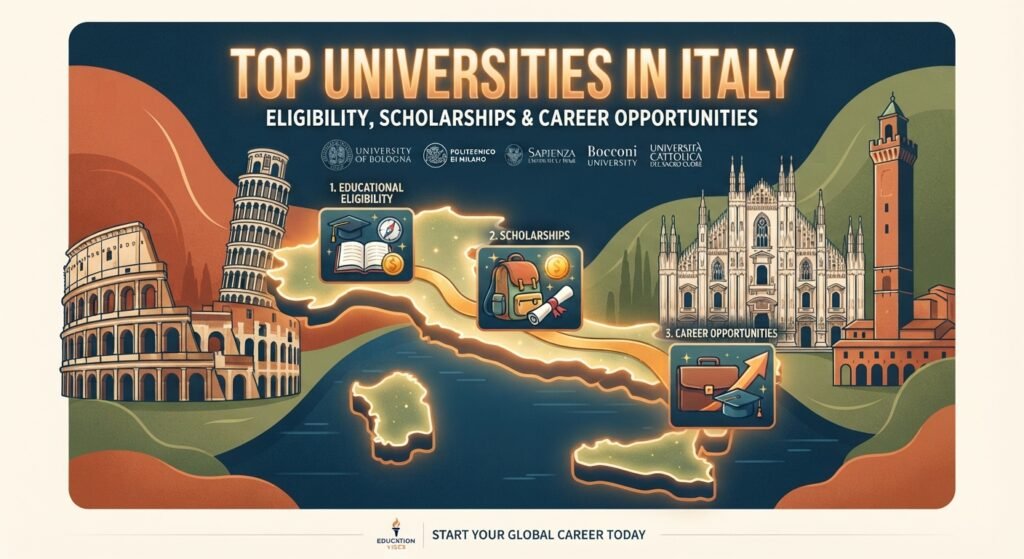
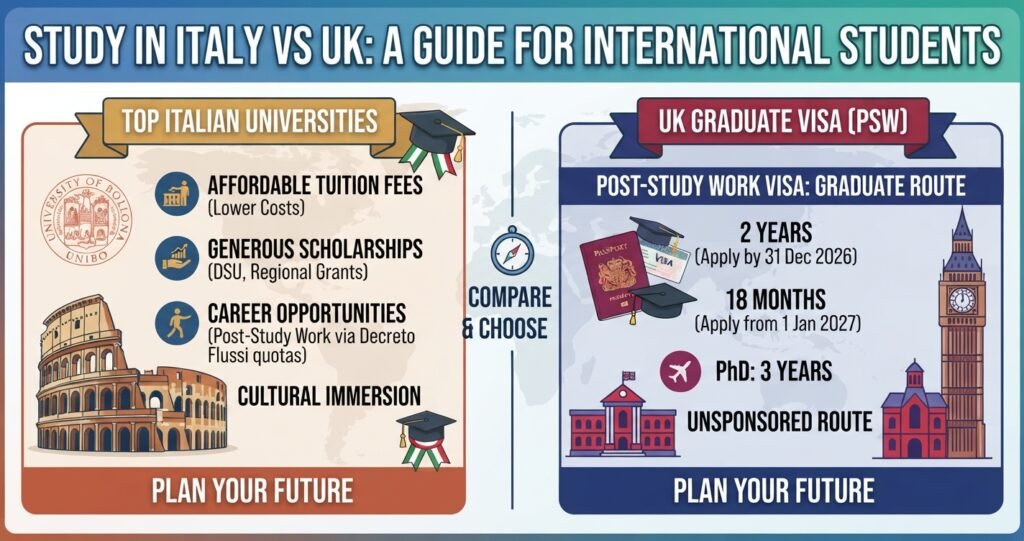
Italy has rapidly emerged as one of the most sought-after study-abroad destinations globally. Projections indicate massive growth in international student enrollment as more scholars recognize the exceptional value proposition Italy offers: world-class higher education, affordable tuition fees, low living costs, and expanding post-graduation career opportunities.
What drives students to choose Italy? Beyond its rich cultural heritage, Italy provides top-tier undergraduate (UG) and postgraduate (PG) programs at a fraction of the cost found in traditional study-abroad hubs like the US, UK, or Australia. Through a combination of income-based fee reductions, regional grants, and prestigious scholarships, many students successfully complete their degrees with minimal out-of-pocket expenses—or even for free.
Can You Study in Italy for Free at Top Public Universities?
Yes, studying in Italy at a very low cost—or entirely for free—is a reality for both EU and non-EU international students. Public universities in Italy achieve this accessibility through several key mechanisms:
- Income-Based Reductions (ISEE): Most Italian public universities calculate tuition fees using the ISEE (Indicatore della Situazione Economica Equivalente), which evaluates a student’s family financial situation. Students who demonstrate an income below established thresholds qualify for the minimum tier of tuition fees or full fee waivers.
- Low Base Tuition Fees: Even without financial aid, standard tuition at Italian public universities typically ranges from €500 to €4,000 per year, depending on the institution and program.
- Government and Regional Scholarships: Regional authorities and national programs provide robust merit- and need-based financial aid, covering everything from monthly stipends to tuition exemptions.
- University-Specific Assistance: Major institutions—such as the University of Bologna, Sapienza University of Rome, and the University of Padua—offer dedicated grants and tuition waivers for high-achieving international applicants.
- Part-Time Work Rights: International students in Italy are permitted to work up to 20 hours per week during the academic year, and full-time during semester breaks, helping cover daily living expenses.
Top Public Universities in Italy for 2026
Italian public universities balance rigorous academic standards with remarkable affordability. Below is an overview of leading public institutions, their standard tuition ranges, domestic rankings, and global standing:
| Name of the University | Tuition Fees (per year) | Rank in Italy | World Rank |
| University of Bologna | €2,000 – €3,000 | 1 | 154 |
| Sapienza University of Rome | €1,000 – €2,500 | 2 | 219 |
| University of Padua | €2,500 – €3,000 | 3 | 236 |
| University of Milan | €1,500 – €3,000 | 4 | 240 |
| University of Pisa | €2,400 – €2,800 | 5 | 349 |
| University of Naples Federico II | €1,000 – €2,500 | 6 | 392 |
| University of Trento | €1,500 – €2,500 | 7 | 445 |
Top UG and PG Courses in Italy
Italian universities offer an extensive catalog of English-taught undergraduate and postgraduate degrees across engineering, design, data science, business, and healthcare.
Undergraduate Programs
- Civil, Mechanical, Electrical, Computer, and Aerospace Engineering
- Fashion and Product Design
- Graphic Design
- Business and Economics
- Business Management
- Tourism and Hospitality Management
Postgraduate Programs
- Master’s in Biomedical Engineering
- Master’s in Civil Engineering
- Master’s in Computer Science
- Master’s in Data Analytics
- Master’s in Graphic Design
- Master of Business Administration (MBA)
Top Career Choices and Earning Potential in Italy
Graduates from Italian universities secure lucrative roles across multiple sectors. While salaries vary based on experience, skill set, and location, average earnings in key industries remain highly competitive:
| Job Role / Career Sector | Average Annual Salary (Euro) |
| Executive Management | €97,680 – €192,000 |
| Data Science and Analytics | €97,680 – €192,000 |
| Healthcare and Medicine | €120,000 – €163,200 |
| Law and Legal Services | €100,000 – €110,760 |
| Aviation | €80,000 – €110,000 |
| Information Technology | €60,000 – €100,000 |
| Marketing and Business Development | €60,000 – €90,000 |
Major Scholarships and Financial Aid Programs
International students aiming to minimize education costs can apply for a variety of prestigious institutional and governmental scholarship opportunities:
- Italian Government Scholarships: Offered by the Ministry of Foreign Affairs for Master’s, PhD, and research paths. Includes a monthly stipend of approximately €900 plus full tuition fee waivers.
- Invest Your Talent in Italy: Tailored for international students pursuing Master’s degrees in Engineering, Economics, or Management, providing a monthly allowance and tuition exemption.
- University of Bologna – Unibo Action 2: Awards up to €11,000 per academic year to talented international students entering first- or second-cycle degree programs.
- Politecnico di Milano Merit-Based Scholarships: Provides €5,000 to €10,000 per year alongside tuition waivers for top-tier candidates in engineering, architecture, and design.
- EDISU Piemonte Scholarships: Financial aid and accommodation packages for students studying in the Piedmont region, allocated based on merit and financial need.
Return on Investment (ROI)
Studying in Italy delivers an extraordinary financial return on investment (ROI). Because public university tuition is heavily subsidized—or fully waived via ISEE and scholarships—initial educational outlays remain minimal.
For instance, students pursuing health sciences or data analytics face manageable academic investments while entering high-demand job markets where annual salaries often range between €40,000 and over €90,000. This low upfront barrier combined with competitive starting salaries allows graduates to achieve an exceptionally rapid financial payback.